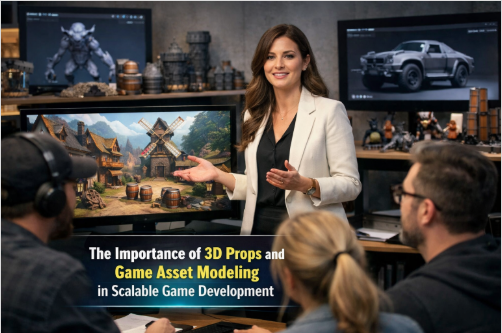
Scalability has become the norm in game development. Games are no longer developed as standalone products but as products that grow over time through expansions, live updates, downloadable content, and even sequels.
In order to achieve this growth without necessarily increasing costs and timelines, the industry requires asset pipelines that are flexible, efficient, and scalable. It is at this point that 3D props and game asset modeling play a crucial role in offering a basis for scalable game development.
Scalability Begins with Asset Design
Scalable development starts with the stage of asset creation. Props and game assets are reused in levels, modes, and systems, and they are used hundreds of times. If assets are not reused, teams will soon find themselves dealing with production pipelines and quality.
Good assets are modular, flexible, and easy to modify. A simple prop can be used as the foundation for many variations by simply changing textures, geometry, or setup. This is very useful in building upon content without having to rebuild assets every time.
Reducing Production Bottlenecks
When projects increase in size, asset generation may become a bottleneck. The process of generating assets for each scenario may be a development bottleneck, especially when working with tight deadlines.
Asset modeling assists in keeping the pace. Reusable assets, resources, and asset organization assist in preventing duplicated efforts. This is especially helpful for studios that develop large worlds, update frequently, or release simultaneously on multiple platforms.
Asset practices that are scalable in the early stages may be beneficial to teams in that they can avoid the costs of rework in the future.
Maintaining Visual Consistency at Scale
One of the most difficult aspects of scalable game development is ensuring consistency when working with large asset libraries.
This will ensure that all the props share a common modeling standard. This is because props that belong to the same world will share a common visual language, which will help in creating an environment that promotes immersion, even when the content increases.
This is particularly important if the assets are being reused for multiple levels or game modes.
Performance Optimization for Large Projects
Scalability is not only linked to production but also to performance. The more assets that are added to a game, the more risks are involved in performance. Unoptimized props that are multiplied in a scene can greatly affect the frame rate and memory usage.
The secret to good 3D props and game asset modeling is detail and optimization. Geometrically clean models, well-optimized UVs, and texture usage are just a few ways to ensure that game assets are light while still looking good. This is important because it allows games to grow in size and complexity while still running well.
Iteration and Live Updates Support
Modern games are very iterative. The gameplay mechanics change, and the feedback from players shapes the changes, and new content is always being added. It is difficult to change assets that are not very iterative.
Scalable assets are made with scalability in mind. A clean topology, logical naming conventions, and a modular architecture make it easier to change or repurpose assets as the design evolves. Scalability is very important in live service games and long-term projects.
Facilitating Effective Cross-Team Collaboration
In the creation of large-scale games, there can be multiple teams working on the same project at the same time. Having proper asset standards and components can make it easier for the teams to work together.
With a uniform asset foundation for all teams, it becomes easier for environments, game mechanics, and UI elements to work well together. This gives a common platform where teams can evolve together and develop faster without compromising on quality.
Leveraging External Expertise for Growth
With the increasing demand for assets, many studios are now turning to third-party companies to help them scale their production. Outsourcing with a 3D game art outsourcing studio will enable the developer to tap into the knowledge of the company without having to hire more people.
The outsourcing studios that have experience in scalable asset creation will understand the requirements of optimization, consistency, and integration. Once the requirements are met in accordance with the art direction and technical specifications of the project, the outsourced assets will integrate seamlessly into the game.
This allows studios to address content requirements while also ensuring that internal teams concentrate on core gameplay and systems.
Reusability Across Projects and Sequels
Scalable assets are more valuable than just in one game. Props with clean structure and neutral foundations can be reused in future projects.
This recycling saves time and money and also provides visual consistency to a franchise. The asset libraries are no longer short-term investments but long-term investments.
Efficiency of Long-Term
Asset pipelines that are scalable can assist in decreasing technical debt. Rather than working on old assets or replacing them, developers can focus on beginning with a solid foundation that encourages growth.
When 3D props and game asset modeling are carried out while taking scalability into consideration, the result is a smoother development process, more accurate timelines, and overall better quality as the projects scale.
Conclusion
The scalability of game development is linked to planning, development, and management related to game assets. Three-dimensional props and game asset modeling is a major part of this, as it helps in reusing, optimizing, and improving game development. Starting from easing production bottlenecks to allowing live updates and future game development, scalable game assets are an important component of a modern game development process. Whether it is done in-house or with the help of a reliable 3D game art outsourcing company, scalable game asset modeling is an investment in the future success of the gaming industry.