
Every new category of marketing eventually has to answer the same uncomfortable question: how do we know it’s working?
With LLM SEO, that question is genuinely tricky — and the honest answer is that the industry is still developing the measurement infrastructure needed to answer it cleanly. That doesn’t mean measurement is impossible. It means you have to be thoughtful about what you’re measuring, why it matters, and how to interpret what you’re seeing.
This is a breakdown of the metrics that actually matter, the reporting frameworks that serious practitioners use, and the numbers that can be gamed versus the ones that are genuinely meaningful.
The Core Challenge: AI Doesn’t Have a Rankings Report
In traditional SEO, you can pull a keyword rankings report any morning and see exactly where you stand. Position 1, position 7, position 24. Clean, legible, comparable over time. You can watch it move as you publish content, build links, and make technical improvements.
LLM visibility doesn’t work like that. There’s no position 1 in an AI-generated answer — there’s mentioned or not mentioned, described accurately or inaccurately, associated with the right category or a fuzzy one. The “ranking” is really a representation quality score, and it varies by query, by AI system, by the moment the question is asked.
This means that LLM SEO reporting requires building a custom measurement system, not pulling from a standard dashboard. The best agencies build this from scratch for each client — a systematic sampling methodology that tests a defined set of relevant queries across multiple AI platforms at regular intervals.
The Metrics That Actually Matter
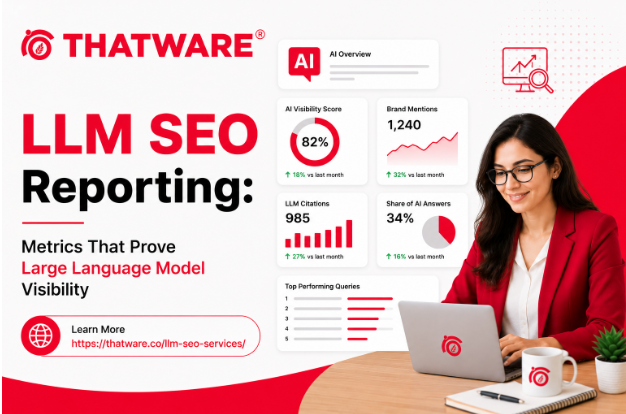
Brand mention frequency. Across a defined set of relevant queries — questions your potential customers are plausibly asking AI assistants — how often does your brand appear in the response? This is your primary visibility metric. Track it over time, by query category, by AI platform.
Mention context and accuracy. This is qualitative but essential. When your brand is mentioned, what does the AI say? Is the product description accurate? Are use cases correctly attributed? Is the brand positioned appropriately relative to competitors? A brand that gets mentioned in AI answers but described inaccurately has a visibility problem even if mention frequency looks decent.
Category association. For a given product or service category, does your brand appear as a relevant option? “Best tools for X” and “companies that help with Y” type queries are often the most commercially valuable — track your performance on those specifically.
Share of voice in AI responses. Compared to your main competitors, what proportion of relevant AI answers include your brand? This competitive context is essential. If you’re going from 0% to 8% mention share while a competitor holds 60%, that’s progress — but it’s context you need to understand.
Accurate entity representation. LLMs build internal representations of entities — your brand, your products, your people, your category. Testing whether those representations are accurate and complete is an important quality metric separate from simple mention frequency.
How to Build a Query Testing Framework
The foundation of LLM SEO reporting is a well-designed query set. This isn’t just a list of keywords — it’s a structured set of questions that reflects how your actual target customers use AI assistants in their buying or research journey.
Good query sets typically cover: category-level discovery questions (“what are the best tools for X?”), comparison questions (“how does [your brand] compare to [competitor]?”), use-case specific questions (“what should I use for Y if I’m doing Z?”), and sometimes people-focused questions if personal brand visibility is part of the strategy.
For a meaningful baseline, you need enough queries to see patterns — usually thirty to one hundred queries depending on the breadth of your market position. Each query gets tested across at least two or three major AI platforms, since ChatGPT, Perplexity, and Google AI Overviews sometimes return meaningfully different results.
The testing methodology matters. Queries should be tested in fresh sessions without personalization effects. Results should be logged verbatim. Over time, what you’re looking for is directional trend — not query-level noise, but the overall pattern improving.
Connecting LLM Visibility to Business Outcomes
This is the hardest part, and I’ll be upfront about that. The attribution chain between “our brand now appears in more AI responses” and “revenue went up” is often indirect and difficult to establish cleanly.
Some signals that help bridge this gap:
Direct referral traffic from AI platforms. Perplexity and some other AI search tools generate referral traffic you can track in analytics. As AI-influenced discovery grows, this traffic stream is worth monitoring separately.
Brand search volume. When someone encounters your brand through an AI answer and then goes to Google to research further, that shows up as branded search. Increasing branded search volume is a meaningful downstream indicator of growing AI-assisted discovery.
Anecdotal client and prospect attribution. In B2B especially, asking “how did you hear about us?” in sales calls increasingly surfaces “I asked ChatGPT” or “I saw it in an AI answer.” Tracking this informally can help validate that AI visibility is influencing pipeline.
Quality LLM SEO services providers build these measurement layers into their reporting from the start — not just tracking AI mention frequency in isolation, but building the connecting tissue to business outcomes. That’s what separates a visibility report from a business impact report.
What Good Monthly Reporting Should Include
A credible monthly LLM SEO report should tell you: how your brand mention frequency changed versus the prior period, what the AI is saying about your brand (with actual sampled responses), how you compare to key competitors, what content or coverage changes correlate with any shifts, and what the next period’s priorities are based on the findings.
It should not be full of vanity metrics, vague language about “improving AI presence,” or dashboards built to look impressive rather than illuminate what’s happening.
The reporting question to always ask your agency: “if I showed this to a CFO, could you explain exactly how each metric connects to our business goals?” If the answer is confident and specific, you’re in good hands. If it involves a lot of hedging and jargon, that’s a signal worth paying attention to.
Best LLM SEO agency partners treat measurement as a core capability, not an afterthought. In a field where results are genuinely harder to pin down than traditional search, measurement rigor is one of the clearest indicators of agency quality. Demand it from day one.






[…] direct answers for users. This shift has created an entirely new field of optimization, where LLM SEO services play a crucial role in helping brands remain visible in AI-generated […]
[…] ensure that AI systems can access, understand, and trust their content. This requires specialized LLM SEO services that focus on AI discoverability and citation […]
[…] remain valuable, but they no longer tell the complete story. Modern businesses require specialized LLM SEO services that measure AI visibility alongside conventional search […]
[…] LLM SEO services ensure that your website provides structured, trustworthy, and context-rich information that AI […]
Comments are closed.